

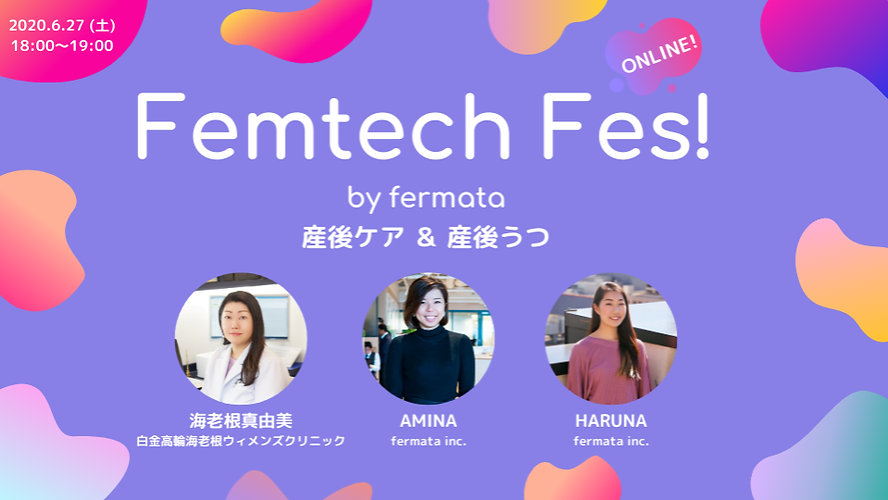
Femtech Fes! Online Vol. 12: "Postpartum Care & Postpartum Depression"
Just when you think you've gotten through pregnancy and childbirth, a woman's body and mind undergo various changes even after giving birth. For first-time mothers, everything can be unfamiliar, and being overwhelmed with childcare can make it difficult to prioritize self-care.
Moreover, many women who have given birth are said to experience postpartum depression. In Japan, there are few survey results regarding the postpartum maternal body, making it difficult to grasp the reality of postpartum depression. As a result, many women are unable to access information or treatment for postpartum depression and end up struggling alone.
At this event, we invited Dr. Mayumi Ebine, director of Shirokane Takanawa Ebine Women's Clinic, who has been researching postpartum depression for over 20 years, as a guest to delve into the health challenges women may face postpartum.
Mayumi Ebine / Shirokane Takanawa Ebine Women's Clinic
She served as a lecturer and ward chief in the maternal-fetal department of the Comprehensive Perinatal Medical Center at Saitama Medical University Hospital. She began treating postpartum depression in 1997 after participating in a research project by the Ministry of Health, Labour and Welfare, and has been engaged in mental health care as the director of Shirokane Takanawa Ebine Women's Clinic since 2013.

In Japan, the postpartum period (or puerperium) refers to the 6 to 8 weeks after childbirth. The typical hospital stay after childbirth in Japan is about 5 days to a week for natural birth and 1 to 10 days for C-sections, whereas in Western countries, discharge on the same day or the day after is common.
"After childbirth, there is a risk of exsanguination from postpartum hemorrhage, so it's desirable to be in an environment with doctors and midwives for at least 24 hours, or ideally 4-5 days for safety," says Dr. Ebine.
However, there are also cost issues involved in maintaining a sustainable health insurance system. The differences in systems and policies across countries became evident.
Among these, afterpains refer to uterine contractions (uterine pain) that occur after childbirth.
"Even after delivering the baby, the uterus is about one liter empty, so it needs to contract back to its original size, which is about the size of a clenched fist. The pain from these contractions is called afterpains."
Afterpains that are too mild are not necessarily good, as a lack of pain can indicate poor uterine involution. We also learned that breastfeeding can aid uterine involution due to hormonal influences.

Postpartum depression is a depressive state caused by emotional and physical factors after childbirth. An initial study by the Ministry of Health, Labour and Welfare found a rate of 13.8%, which is why it is generally said in Japan that "approximately 10% of mothers experience postpartum depression." However, because psychiatrists do not examine all women who have given birth, it is difficult to ascertain the exact figures. Even data using a well-known British scale is said to capture only about 30% of the total.
"I want people to know that postpartum depression is by no means something special that happens to a limited number of people. It's also important for societal perceptions to change. It can happen to anyone, so if you feel down after childbirth, don't be surprised and please consult with friends or a doctor."
Recent research suggests that depression is linked to poor nutrition and malnutrition, so it's possible that societal pressure to quickly regain one's figure also contributes to postpartum depression.
"It's currently difficult to establish preventative methods as it's not clear whether it's due to environmental factors or hormonal influences. However, because delaying the return to society can make one more susceptible to depression, it's possible to take measures to avoid creating situations that lead to negative thinking (such as not being able to return to work as planned). For example, plan your return to work with plenty of leeway, and if you settle in sooner, you can bring your plans forward."
Regarding treatment, she said, "In my experience, medical support at public health centers is more practical than treatments covered by insurance, such as prescribing antidepressants at a psychiatric clinic. In recent years, child guidance centers have also changed their approach to proactively prevent child neglect. Public health nurses are always available, so consulting them first will likely lead to a solution."
At the end of the event, we also introduced "Femtech Solutions that support postpartum women" from around the world.
Elvie Trainer
A smart device focused on pelvic floor issues, designed to train the pelvic floor muscles postpartum.
It measures pelvic movement with force sensors and links to an app, allowing for game-like training.
Elvie Pump
The world's first wearable breast pump. Worn inside a nursing bra.
Connects via Bluetooth to an app, allowing control via smartphone and tracking of milk output and pumping history.
Lilu
A massage bra that supports milk expression.
Prevents pain from engorgement and blockages, and reduces the risk of mastitis. Currently being improved as a medical device.
iBreve
A wearable device worn on the bra.
Transmits data on breathing patterns, activity levels, and stress levels to a smartphone. Visualizes stress levels on the app and provides information on breathing techniques to relieve stress.
Peanut
"Tinder" for mothers.
Focuses on finding friends with common interests (languages spoken, full-time employment status, outdoor personality, children's ages, etc.). Synchronizes calendars to find convenient times to meet up.
There are also communities where mothers can exchange information about workplaces that accommodate working mothers.
Maven Clinic
An online platform where mothers can consult healthcare professionals about health and medical issues (lactation consultants, sleep coaches, mental health specialists, career coaches, pediatricians, breast milk delivery services, etc.). 90% of Maven Clinic members return to work (US average: 57%).
Many might be interested in trying products that automatically express milk or provide massages, wouldn't they?
Postpartum depression is still not fully understood, and I felt that it is also a societal issue. I hope this event can be an opportunity for those who have experienced or will experience childbirth, and those around them, to find support that suits them, even if only a little.